

DRIVING POLICY CHANGE TO PROTECT
WOMEN’S BREAST HEALTH
TAKE ACTION.
DEMAND ACCESS.
Learn more about current legislation that impacts women's access to equitable breast healthcare and take action to drive change.
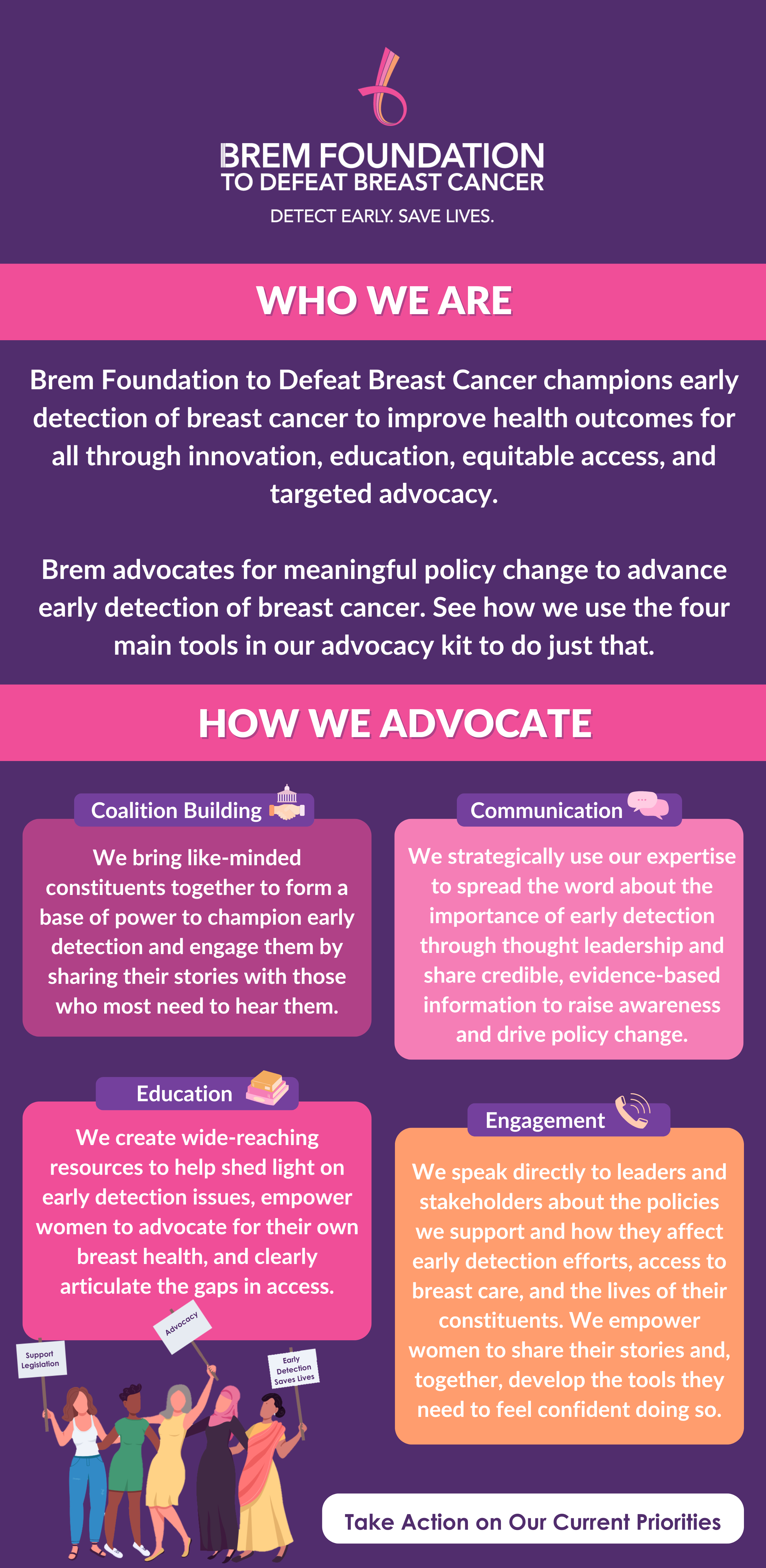
Early detection of breast cancer saves lives. At the Brem Foundation, our priority is ensuring that early detection is a priority for leaders and stakeholders. Click the infographic below to see how we advocate for meaningful policy change in support of early detection of breast cancer.
Learn How We Advocate.

ELIMINATE OUT-OF-POCKET COSTS FOR DIAGNOSTIC BREAST IMAGING
The Access to Breast Cancer Diagnostics (ABCD) Act, would protect patients from exorbitant, unexpected costs and empower them to seek treatment earlier, increasing their chances of survival.
Ready to make your voice heard? We've made it easy to contact your representative by emailing them. Don't worry - we'll give you the exact words to use. Take action below!

HELP LOW-INCOME, UNINSURED, AND UNDERINSURED WOMEN ACCESS CRITICAL BREAST CARE
Since 1991, the National Breast and Cervical Cancer Early Detection Program (NBCCEDP) has served more than 6 million women, detecting nearly 74,000 invasive breast cancers and over 23,000 premalignant breast lesions. However, if the Screening for Communities to Receive Early and Equitable Needed Services (SCREENS) for Cancer Act is not passed, this program could end, and millions of women from underserved communities will lose access to the preventive screening and treatments that save lives.
Ready to make your voice heard? We've made it easy to contact your representative by emailing them. Don't worry - we'll give you the exact words to use. Take action below!

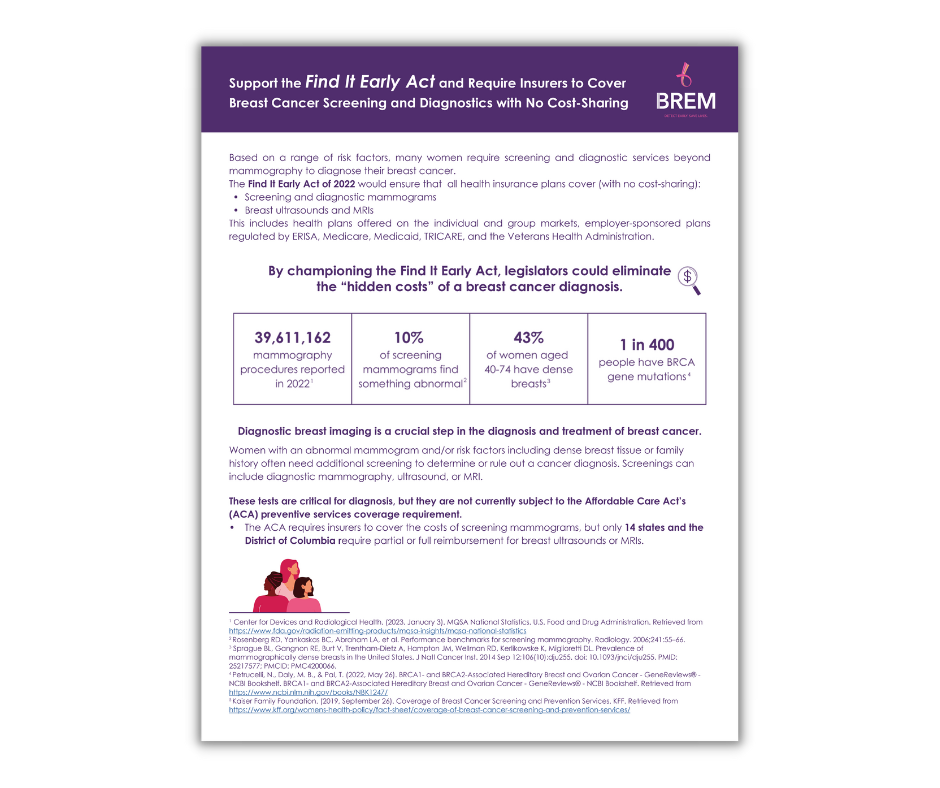
INSURERS MUST COVER BREAST SCREENING AND DIAGNOSTICS WITH NO COST-SHARING
The Find It Early Act will ensure that women never have to compromise their breast health—or their lives—because they cannot afford critical screening and early detection services.
Download our fact sheet to see how this legislation could eliminate the "hidden costs" of a breast cancer diagnosis.
Ready to make your voice heard? We've made it easy to contact your representative by emailing them. Don't worry - we'll give you the exact words to use. Take action below!
CHAMPION INCREASED ACCESS TO LIFESAVING MULTI-CANCER EARLY DETECTION SCREENING TESTS
Passing the Nancy Gardner Sewell Medicare Multi-Cancer Early Detection (MCED) Screening Coverage Act will improve future equitable access to new and innovative cancer screening methods. Innovative blood tests—otherwise known as liquid biopsy— hold the potential to detect cancer earlier than ever before, while dramatically improving cancer detection capabilities.
Download our fact sheet to learn how this legislation could improve the quality of life for millions of American cancer patients.
Want to help advocate for the MCED Screening Coverage Act? Let your Congressional representatives know that they must do more to ensure that all seniors with Medicare have access to lifesaving, multi-cancer early detection screenings. Take action below!

ENSURE ALL INDIVIDUALS WITH GENETIC RISKS FOR HEREDITARY CANCERS RECEIVE IMPROVED ACCESS TO EXPANDED COVERAGE
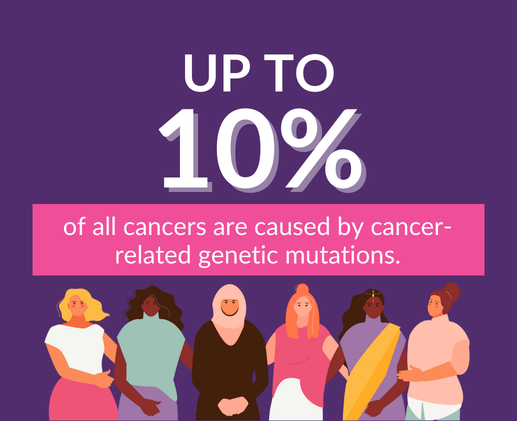
Up to 10% of all cancers are caused by cancer-related genetic mutations.
The Reducing Hereditary Cancer Act (RHCA) aims to provide expanded coverage for at-risk Medicare beneficiaries, particularly those with genetic risks for hereditary cancers, and addresses a pressing need for increased access to genetic counseling, testing, cancer screening, and preventive care.
Help us champion the Reducing Hereditary Cancer Act. Contact your elected representatives and express your support for the act—urge them to prioritize this vital legislation to improve access for at-risk individuals. Take action below!
LEARN ABOUT OUR ONGOING ADVOCACY WORK
Thirty-eight states and the District of Columbia require some notification to women who receive mammograms about breast density, but that is not enough. In March of 2019, the U.S. Food and Drug Administration (FDA) proposed amendments and updates to the Mammography Quality Standards Act (MQSA). This amendment was intended to “modernize breast cancer screening and help empower patients with information when they are considering important decisions regarding their breast health care.” Part of this proposal includes standardized notification of breast density levels in all mammography reports across the U.S.
*Note: Nothing in the rule prohibits states from enacting breast-density notification laws that are at least as stringent as those in the federal rule.
Breast Cancer Guidelines: A Call to Action
In 2024, the United States Preventive Task Force updated its breast cancer screening guidelines. While they did recommend that breast cancer screening begin at age 40 (a long overdue adjustment from age 50)—but they only recommend screening every two years. This decision was made without any new evidence or studies. Even more concerning is the USPSTF's failure to recommend additional screening for women with dense breast tissue, ignoring robust scientific data showing that ultrasound, MBI, ultrasound tomography, and most effectively, MRI, can detect cancers that mammography alone cannot identify.
Women with dense breasts are particularly vulnerable to later-stage diagnoses. Research shows that supplemental screenings can find nearly as many cancers as mammography and that MRI can find three times as many cancers after a normal mammogram. For the USPSTF to conclude that there is "insufficient evidence" to recommend additional screening is simply unacceptable.
Adding to the urgency, breast cancer rates among younger women are rising. Between 2010 and 2019, cancer diagnoses among people aged 30 to 39 increased by nearly 20%, with breast cancer accounting for the highest number of cases. There are similar findings for women in their 40’s. The USPSTF's current recommendations do not adequately address these alarming trends.
Women Deserve Better
Read more HERE.
DC Breast Density Notification Law
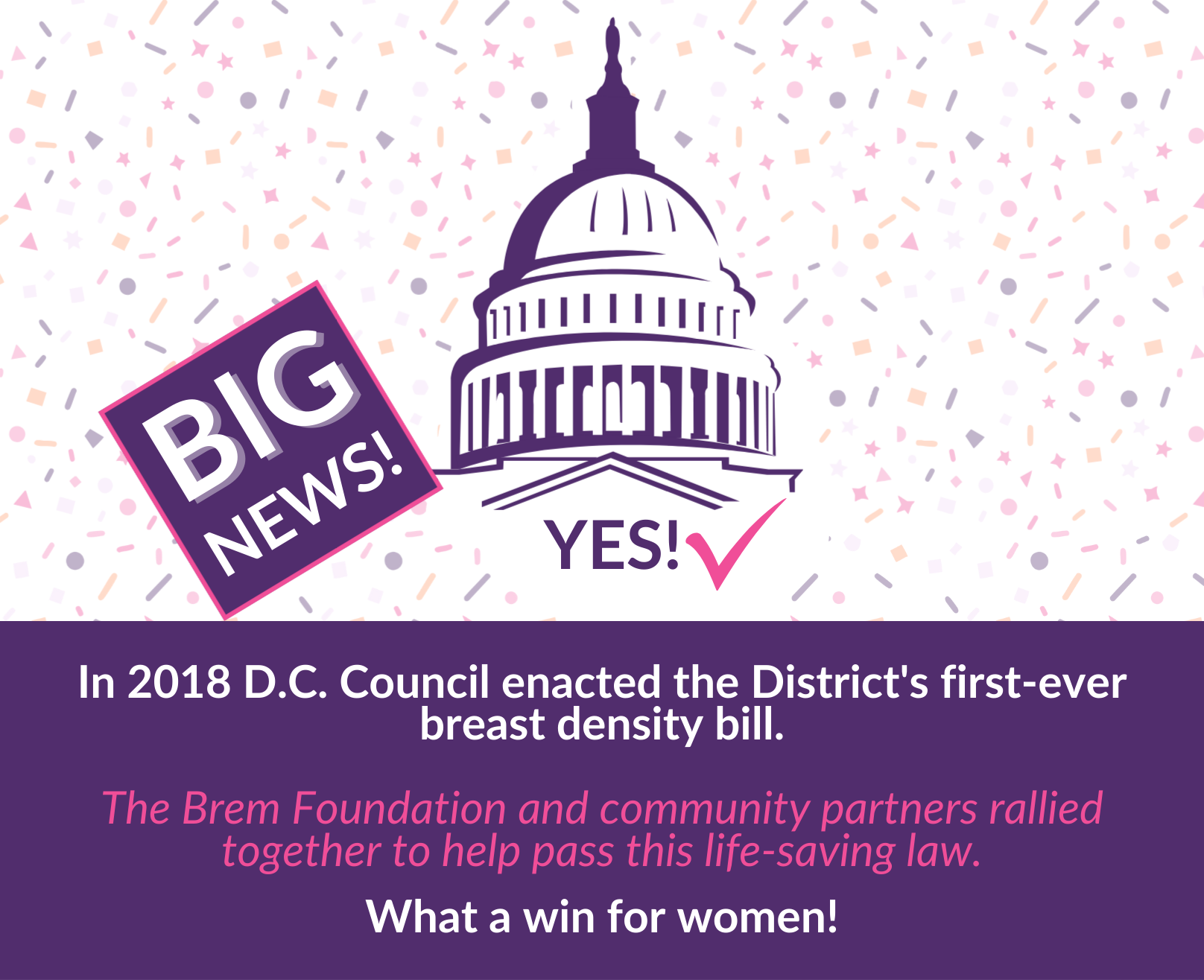
The Brem Foundation drafted and helped pass D.C.’s first-ever breast density law. The Dense Breast Screening and Notification Act of 2018 (D.C. Law 22-261) was unanimously passed at the end of 2018 and became effective on March 22, 2019.
The law requires health care facilities to include mammography results, including patients' breast tissue classification. This law also requires insurance coverage for the essential screenings that women with dense breasts and other risk factors need beyond just mammograms. To view the text of the law, click HERE.